

The Robot Can't Sing
On perfection, soul, and the difference between a restaurant and its imitation.

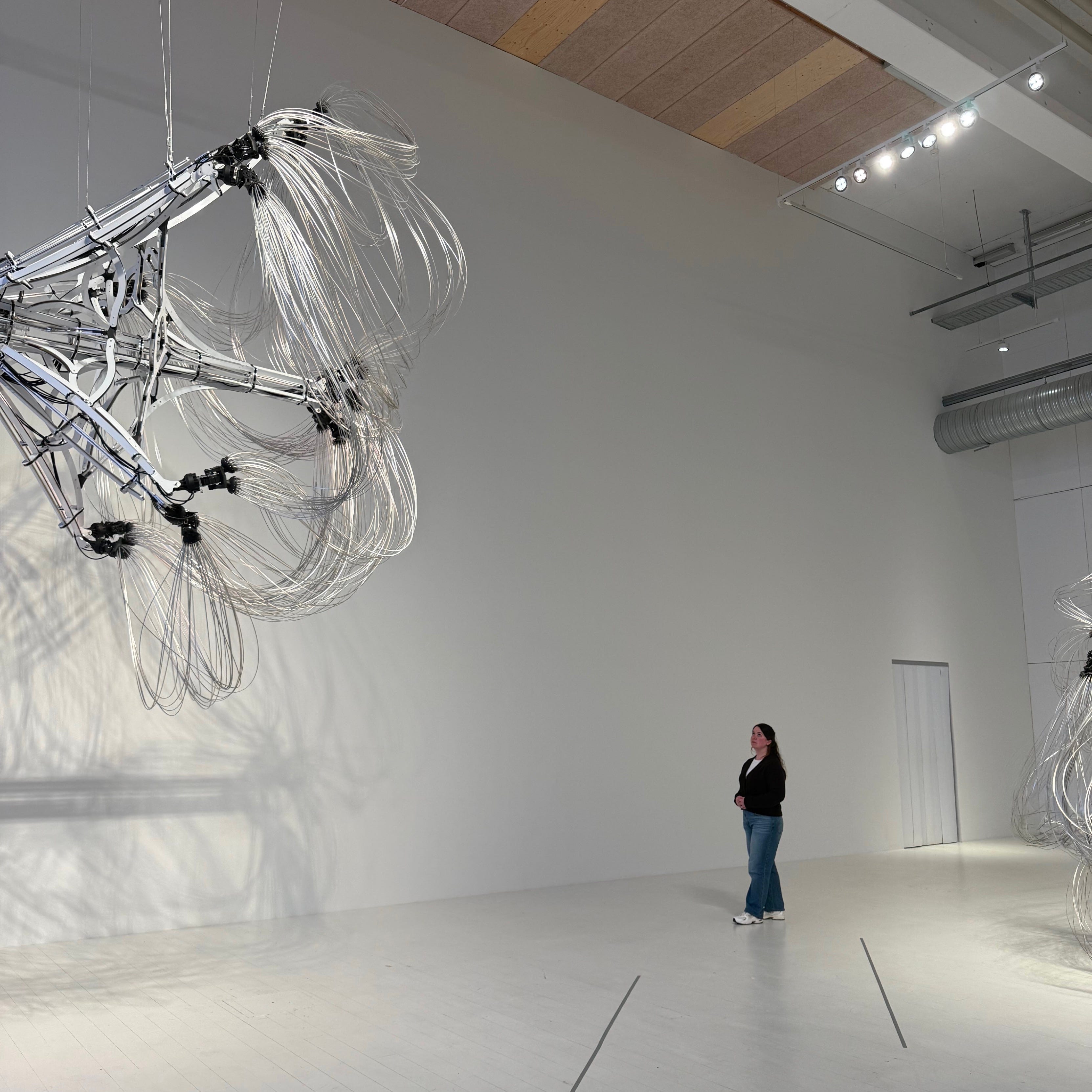
In February, my wife and I went to Copenhagen for five days of dissociation through food and wine. While there, we made the walk from our hotel to the Copenhagen Contemporary, where an exhibit called Soft Robots was being shown. I had not known what was on, but as I walked around, I saw so many great (and disturbing) similarities with restaurants.
The subtitle of the exhibit was The Art of Digital Breathing, seemingly a dichotomy. The conceit is that the work is alive in some provisional, uneasy way. Machines built from silicone and frog cells and live neurons, rather than just steel. One of them released slow rounds of smoke which drift high above our heads and burst into nothingness. The writing on the wall suggests that the exhibit breathes. And it does, although it is not alive.
The principal question is one that has been circled for decades — if not longer — but seems all the more pertinent today. Can a machine have a soul? They reach, over and over, for the same story to question it. Hans Christian Andersen’s The Nightingale, written in 1843, by a Dane watching the industrialisation of the world around him.
The story goes that in his porcelain palace, a Chinese emperor discovers that the most celebrated thing in his empire is a little nightingale which he has never heard sing. The whole world has written books and poems about it, living wild in the woods down by the sea. The emperor has it brought to his court. Then, a gift arrives from the emperor of Japan, a mechanical nightingale, gold and diamond encrusted, which performs a single flawless tune in perfect time. Over time, the court comes to prefer it, because it is predictable and perfect. They could sing along, by heart. The bird never tires, and never surprises. Meanwhile, the real bird slips back to the forest.
Those who had heard the live nightingale could tell the difference. The mechanical one sounded beautiful, undeniably, almost exactly like the real thing, although something nearly imperceptible was missing. One night, the mechanical bird breaks, and the music stops. Years later, the emperor lies on his deathbed, and the living nightingale returns, singing Death out of the room.
I stood in front of all this circuitry and felt discomforted, as a man who tries to make dining rooms run smoothly, that I may have been trying to build the golden bird. Because that is what some restaurants have become. Frictionless. Tuned to perfection, hitting the same notes every service. The same dishes land on the same plate, at the same temperature, every service, and the staff offer up the same greetings and platitudes to each and every table that they serve, until nothing wavers and nothing surprises, nor delights, and eventually, nothing moves you.
But the purest form of the golden bird is not the independent restaurant, it is the chain. A hundred identical rooms run from a corporate handbook, where the uniform is specified down to the button, and the service to the syllable, and the menu hasn’t changed in years, because to do so would be to trust someone to make a decision. That is the golden bird, perfect, reproducible, the same in Leeds as in Lisbon. And that perfection is why it will always be imperfect. It is merely an imitation of a real restaurant.
It does, of course, creep into smaller places too — I have felt it creep into mine — although in an independent restaurant it is usually, at most, a temptation rather than the goal.
Our menus have always been designed to change frequently. Our team, although asked to hit certain steps, are never handed a script, because a script is only one step removed from a handbook and I’d much rather hear a slightly clumsy sentence that someone meant, over a flawless one that they were told to say. Warmth over technical perfection, every time, although both are preferable. That is very easy to write, but hard to sit with, because warmth is inconsistent by its very nature, and inconsistency can be frightening.
And sometimes, I overcorrect. I tighten things that didn’t need it, and I’ve caught myself, more than I’d care to admit, smothering a room until it looked like a mechanical bird. What I fear is that someone (or even I) will walk into one of my restaurants and feel nothing at all. No wobbles, no warmth, only the clean, sterile buzz of a place that runs perfectly and has no soul.
Han Kang, in Greek Lessons, sets down three sentences magnificently. The beautiful is beautiful, the beautiful is noble, the beautiful is difficult. It’s the final one that resonates with me. Beauty is difficult because difficulty is what it’s made from. The song moves you because the bird might falter, because it’s tired, or the night is cold, and it could fail, but instead, this time, it succeeded.
A machine can’t give you that. The golden bird never struggles, and so it never achieves anything. The Octobot, which the show calls the first fully soft robot, moves on a chemical reaction between two liquids and has not the faintest idea that it is moving. Its body, the label says, is insensitive to the world around it. There is nothing at stake, nothing is difficult, and so nothing it does is beautiful, regardless of how flawlessly it does it.
The fear is that the machines are coming for our song, but I’m not worried about that. The machine will learn the notes, better even than we can. But it will never find them difficult, and it will never stand in a cold garden, with a chance of failing, and sing anyway. That is what we get to keep for ourselves, for as long as we are willing to sit with difficulty. The golden bird was perfect and gave the emperor nothing, right up until it broke. I would far prefer that we falter with intention, and that I walk into a room one evening and feel something, even if it feels a little wrong, than the smooth, sterile nothing of a place that has finally been perfected.
Good stuff Dan - the balance of consistency and authenticity is difficult, I for one don't want perfection without emotion
So true. I don't want a grain of sand to remind me that spinach grows in soil, but I do love knowing that the food was prepared with care; that the servers present it to me with that knowledge so I as diner will do so with full appreciation. Thank you to all restauranteurs from greasy spoon to fine dining for doing what they do best